
Spiti Valley Travel Guide 2027: Monasteries, Villages, Routes, Best Time and Itinerary

Quick answer: This Spiti Valley travel guide covers where Spiti is, what to see and how to get in by season. Spiti is a high-altitude cold desert in Lahaul and Spiti district, with a valley floor between about 2,950 and 4,100 metres. Its main town, Kaza, is at about 3,650 metres. The must-sees are Key, Tabo and Dhankar monasteries, the villages of Kibber, Langza and Hikkim, Pin Valley National Park and Chandratal Lake. The road from Shimla through Kinnaur is open the whole year, while the Manali-Kaza road over Kunzum Pass is closed for about 7 winter months.
Spiti feels like a different country from the rest of Himachal. It lies in the rain shadow of the main Himalayan range, so it is dry and lies largely above the tree line, with monasteries more than a thousand years old. It is also one of the least populated regions of India, which means long drives, few services and real altitude. This guide covers how Spiti is laid out, the monasteries and villages worth your time, Pin Valley and Chandratal, the routes in by season, a 10-day itinerary, altitude advice and practical tips. Every fact is checked against the sources at the end.
Spiti Valley at a Glance
| District | Lahaul and Spiti (district headquarters at Kyelang, in Lahaul) |
|---|---|
| Valley floor | About 2,950 to 4,100 m |
| Main town | Kaza, about 3,650 m, on the Spiti River |
| Area and population | 7,828.9 sq km; 17,104 people (2011) |
| Climate | Arid cold desert; about 50 mm of rain a year |
| Year-round route | Shimla, Kinnaur, Pooh, Tabo, Kaza |
| Seasonal route | Manali, Atal Tunnel, Kunzum Pass, Kaza (closed about 7 winter months) |
| Fuel | Kaza has the only petrol pump in the Spiti Valley |
Spiti Valley Travel Guide: Geography and People
Spiti is a high-altitude region of the Himalayas in the north-east of Himachal Pradesh. It is bordered by Tibet to the east, Ladakh to the north, Lahaul to the west and southwest, Kullu to the south and Kinnaur to the southeast. The valley covers 7,828.9 square kilometres, and its total population in 2011 was just 17,104, which makes it one of the least populated regions of India.
Because Spiti sits in the rain shadow of the main Himalayan range, it does not get the south-west monsoon that brings rain to most of India from June to September. Average rainfall is only about 50 mm a year. The landscape is a cold desert, and the valley floor runs from about 2,950 to 4,100 metres. Kaza, the sub-division headquarters, sits on the bank of the Spiti River at about 3,650 metres, while the district headquarters is at Kyelang in Lahaul.
The Bhoti-speaking local population follows Tibetan Buddhism, and the Gelug, Nyingma and Sakya schools all have monasteries in the valley. For the rest of the state, see our Himachal Pradesh travel guide.
Monasteries of Spiti
Key Monastery
Key Monastery is a Gelugpa monastery on a hilltop at about 4,166 metres, close to the Spiti River and about 12 km north of Kaza. It is the largest monastery in the Spiti Valley and a religious training centre for lamas. Its founding is traditionally linked to Dromtön, a pupil of the teacher Atisha, in the 11th century.
Tabo Monastery
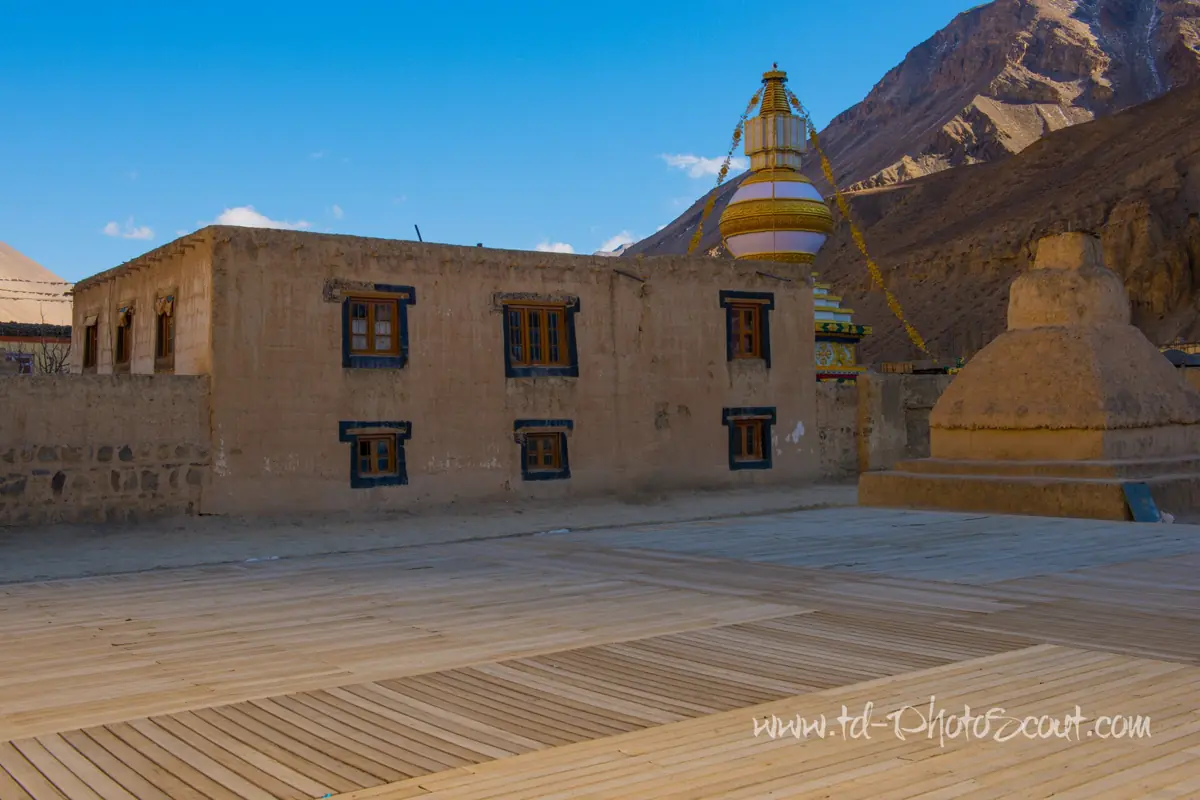
Tabo Monastery, in Tabo village, was founded in 996 CE by the Tibetan translator Rinchen Zangpo on behalf of the king of Guge. It is noted as the oldest continuously operating Buddhist enclave in both India and the Himalayas. The complex includes 9 temples, 4 stupas and 23 chortens, and it is known for its large number of frescoes.
Dhankar Monastery
Dhankar Monastery sits at about 3,894 metres above Dhankar village, between Kaza and Tabo, overlooking the confluence of the Spiti and Pin rivers. Its name means “fort on a cliff”, and it was built as a fort monastery. Dhankar was the traditional capital of the Spiti Valley kingdom in the 17th century. A branch road of 8 km climbs to it from the main road.
Villages Worth Visiting
Kibber
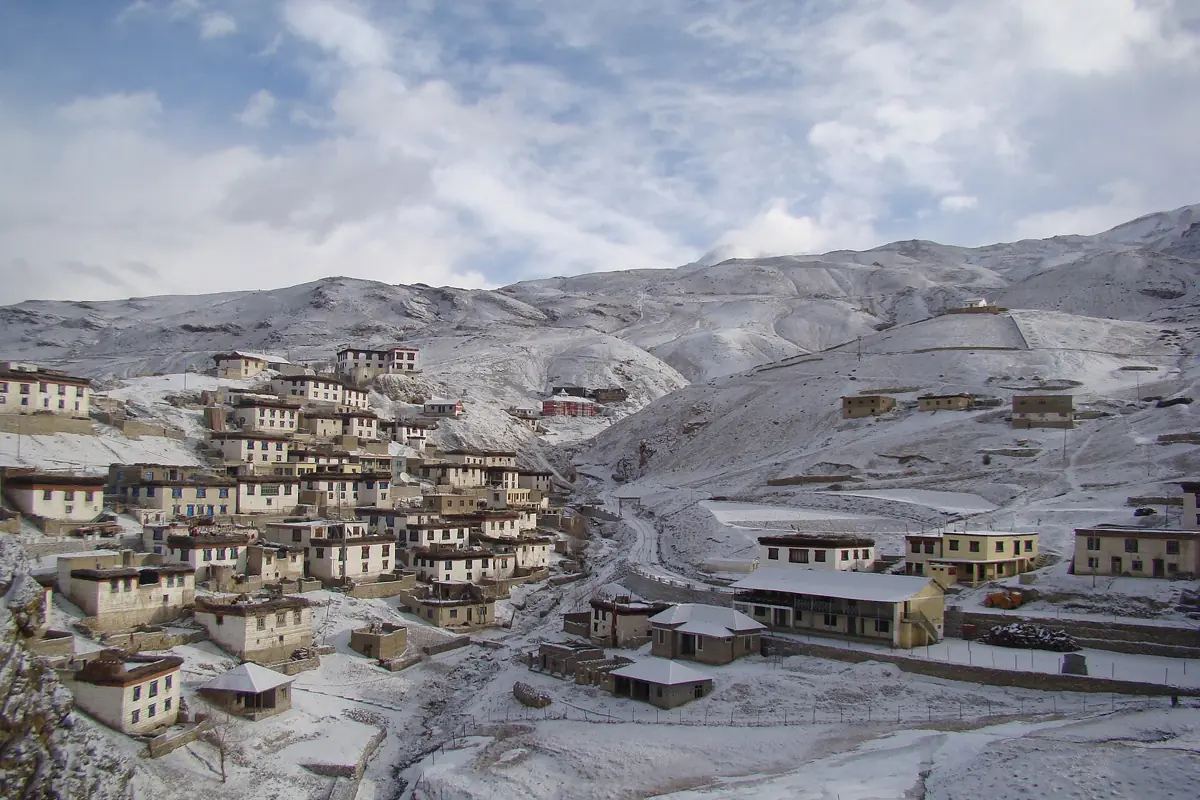
Kibber sits at about 4,270 metres, 19 km from Kaza, and is one of the highest villages in the world inhabited year-round. A bus connects it with Kaza. It has a monastery and is the base for the Kibber Wildlife Sanctuary, home to about 30 snow leopards. Several homestays have been set up, and local guides lead treks from the village.
Langza
Langza, at about 4,420 metres, is known as the “fossil village” of Spiti, and a large Buddha statue overlooks it. It is a tiny place: its population was 136 in 2011.
Hikkim
Hikkim has a post office at an elevation of 4,400 metres, one of the highest post offices in the world. It makes a natural stop on a day tour of the villages around Kaza.
Komic, Demul and Mud
Komic, Demul and Mud are other villages popular with visitors. Mud is in the Pin Valley, where its nunneries belong to the Nyingma school, as does the Kungri monastery.
Pin Valley National Park and Chandratal Lake
Pin Valley National Park
Spiti has two protected areas: Pin Valley National Park and Kibber Wildlife Sanctuary. Pin Valley National Park ranges from about 3,500 metres to more than 6,000 metres. Its higher reaches are habitat for endangered animals including snow leopards, Siberian ibex and bharal (Himalayan blue sheep), along with red foxes, weasels, martens and pikas.
Chandratal Lake
Chandratal Lake lies at about 4,250 metres and is frozen from December to March. It is reachable by road from Batal, and by road or on foot from Kunzum Pass, from late May to early October. The motor road ends at a parking area 1 km from the lake. It was designated a Ramsar wetland on 8 November 2005.
How to Reach Spiti: Routes by Season
| Route | Open | Notes |
|---|---|---|
| Shimla, Kinnaur, Pooh, Tabo, Kaza | The whole year | The only way in during winter |
| Manali, Atal Tunnel, Kunzum Pass, Kaza | Only while Kunzum Pass is open | Closed for about 7 winter months; opening depends on the weather and road clearing by the Border Roads Organisation |
On the Manali side, Kunzum Pass on NH 505 is 122 km from Manali and 79 km from Kaza. The 9.02 km Atal Tunnel gives all-weather access from Manali to the Lahaul-Spiti valley, but the road onwards to Kaza still crosses Kunzum Pass. In summer you can do a circuit: in through Kinnaur and out over Kunzum to Manali, or the reverse.
For the road into the valley from either side, see our guides on Shimla and Manali.
Best Time to Visit Spiti Valley
| If you want | Go | Why |
|---|---|---|
| The full circuit including Kunzum Pass and Chandratal | Late May to early October | Chandratal is reachable in this window; Kunzum opens once the BRO clears it |
| Winter Spiti | Through Kinnaur only | The Kaza-Pooh-Tabo-Shimla route is open the whole year |
| Dry weather | Any time | Spiti is in the monsoon rain shadow, with about 50 mm of rain a year |
Spiti Valley Itinerary: 10 Days
- Day 1: Shimla to Narkanda or Rampur.
- Days 2–3: Kinnaur: Sangla Valley, Chitkul and Kalpa.
- Day 4: Kalpa to Tabo; Tabo Monastery.
- Day 5: Tabo to Kaza via Dhankar Monastery.
- Day 6: rest day in Kaza to acclimatise; fill up at the petrol pump.
- Day 7: Key Monastery and Kibber.
- Day 8: Langza, Hikkim and Komic.
- Day 9: Pin Valley.
- Day 10: Kaza to Chandratal, then over Kunzum Pass to Manali (only while the pass is open; otherwise return via Kinnaur).
Altitude and Health in Spiti
Kaza and most of the valley floor lie above 3,000 metres, and villages such as Kibber and Langza are above 4,200 metres. Go up slowly, drink enough water, do not drink alcohol and plan rest days. Altitude sickness starts with symptoms such as a headache, feeling sick, tiredness and dizziness. It usually gets better with rest but can sometimes be life-threatening, so get medical help if symptoms get worse.
What to Pack for Spiti
- Warm layers: thermals, a fleece and a down jacket, even in summer, because most of the valley floor is above 3,000 metres.
- Sun protection: sunglasses, sunscreen, a hat and lip balm for the dry, high-altitude air.
- Health kit: your personal medicines, a basic first-aid kit and a refillable water bottle.
- Cash: enough for homestays and fuel, since services are far apart.
- For drivers: a spare tyre, a tow rope and snacks, and a full tank before leaving Kaza.
- Paperwork: carry a photo ID and printed copies of your bookings, as mobile coverage can be patchy in remote stretches.
Spiti Travel Tips
- Fill your tank in Kaza; it has the only petrol pump in the Spiti Valley.
- Carry enough cash and some spare food; services are far apart.
- Pack warm layers even in summer; nights at 4,000 metres are cold.
- Check the status of Kunzum Pass and the Kinnaur road before you set out.
- Stay in village homestays in Kibber to support local families.
- For a side-by-side list of Himachal destinations, see places to visit in Himachal Pradesh.
More Spiti Valley guides
- Himachal Pradesh Travel Guide 2027: Where to Go, When to Go and How to Get There
- Manali Travel Guide 2027: Places to Visit, Weather by Month, Itinerary and How to Reach
- Shimla Travel Guide 2027: Places to Visit, Day Trips, Weather and How to Reach
- Dharamshala Travel Guide 2027: McLeod Ganj, Triund, Weather and Places to Visit
- Kasol Travel Guide 2027: Parvati Valley, Manikaran, Malana, Kheerganga and How to Reach
Spiti Valley Travel FAQs
Can you visit Spiti Valley in winter?
Yes, but only through Kinnaur. The Kaza, Pooh, Tabo and Shimla route is open the whole year, while the Manali-Kaza route is closed for about 7 winter months.
How high is Kaza?
About 3,650 metres, on the bank of the Spiti River.
Which is the oldest monastery in Spiti?
Tabo Monastery, founded in 996 CE, noted as the oldest continuously operating Buddhist enclave in India and the Himalayas.
Which is the largest monastery in Spiti?
Key Monastery, about 12 km north of Kaza at around 4,166 metres.
Where is the highest post office in Spiti?
In Hikkim, at an elevation of 4,400 metres; it is one of the highest post offices in the world.
Can you see snow leopards in Spiti?
Kibber Wildlife Sanctuary is home to about 30 snow leopards, and Pin Valley National Park is also snow leopard habitat. Ask local guides in Kibber about sightings.
Does it rain in Spiti during the monsoon?
Very little. Spiti is in the rain shadow of the main Himalayan range and averages about 50 mm of rain a year.
Is there a petrol pump in Spiti?
Yes, in Kaza. It is the only petrol pump in the Spiti Valley.
Photos: Dhankar Gompa by Deepank Ranka (CC BY-SA 4.0); Tabo Monastery by Tim Dellmann (CC BY 3.0); Kibber village by Ksuryawanshi (CC BY-SA 4.0); all via Wikimedia Commons.
Last verified: November 2026 by the Tourtravelinfo Team. Road openings in Spiti change every year; check the latest status before you set out.
- Spiti (Wikipedia)
- Key Monastery, Tabo Monastery, Dhankar Monastery (Wikipedia)
- Kibber, Langza, Hikkim, Kaza (Wikipedia)
- Pin Valley National Park, Chandra Taal, Kunzum Pass (Wikipedia)
- New India Samachar (PIB): Atal Tunnel
- NHS: Altitude sickness